Veo 3.1 from Google: The Video Generation Model that Strikes with Physical and Cinematic Realism
Veo 3.1 update combines 4K resolution, original synchronized audio, and improvements in prompt adherence, but remains limited to 8 seconds and faces strong competition in the leaderboard.
AI DayaHimour Team
April 5, 2026
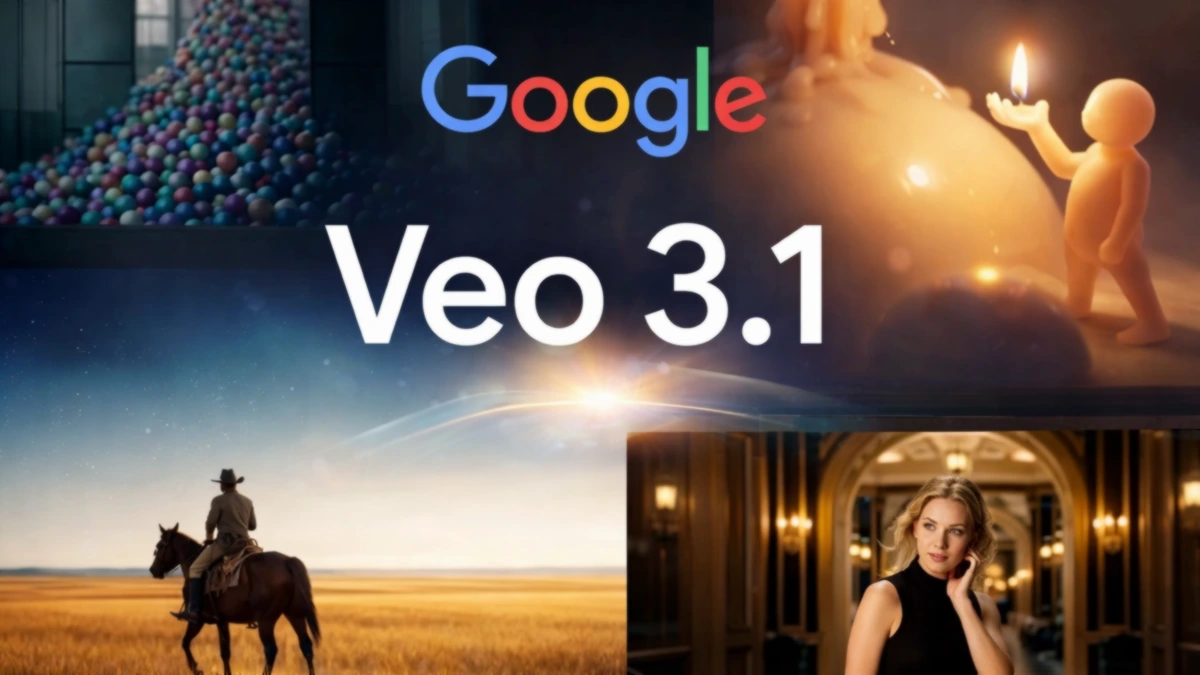
In October 2025, Google launched Veo 3.1, the updated version of the video generation model announced in May during its I/O event. The update was not just a routine upgrade; it came with tangible improvements in original synchronized audio quality, adherence to text prompts, and physical realism that makes movements appear completely natural. Then the January 2026 update titled “Ingredients to Video” added better support for reference images, vertical 9:16 video production ready for YouTube Shorts, and upscaling to 4K resolution. The result: a model targeting real production use more than just entertainment.
Veo 3.1 is not a chatbot that produces random video. It is a system built on a latent diffusion model that processes video and audio together, allowing generation of synchronized dialogue, sound effects, and background music matching the visual context. The maximum duration per clip is 8 seconds (4, 6, or 8 seconds depending on settings), with the possibility of extension via chaining or adding leading/trailing frames. Resolution reaches 4K in advanced mode, with aspect ratios 16:9 or 9:16, at 24 frames per second. These specifications make it suitable for short advertisements and social content more than for long‑form movies.
The Fundamental Difference Between Veo 3 and Veo 3.1
Veo 3 introduced original synchronized audio for the first time, but it sometimes suffered from lack of precision in true texture and prompt adherence. Veo 3.1 improved that noticeably: richer, more natural audio, more cinematic camera movement, and deeper understanding of directing styles. The additional update in January focused on “ingredients” i.e., reference images, so it now better preserves characters and backgrounds and allows adding new elements that harmonize with the existing style. Some users noted that Veo 3.1 is 8‑12% slower without audio, and the increase reaches 25‑30% with audio, but the final quality justifies the difference in most production cases.
How Veo 3.1 Stands Against Competitors on the Artificial Analysis Leaderboard
Veo 3.1 does not occupy the top position on every leaderboard, but it remains a strong competitor. According to the latest Artificial Analysis data from April 2026:
| Approximate Rank | Model | Elo Score (Text‑to‑Video) | Key Strengths | Notable Weaknesses |
|---|---|---|---|---|
| 1‑3 | Kling 3.0 Pro | ~1241 | Human realism, smooth motion | Less integrated audio |
| 4‑5 | Runway Gen‑4.5 | ~1230 | Accurate physics, prompt adherence | No original synchronized audio |
| ~13 | Veo 3.1 | ~1215 | Excellent synchronized audio, texture realism | Short duration, high cost |
| ~12 | Sora 2 Pro | ~1205 | Strong physical simulation, coherent narrative | Less flexibility in cinematic control |
| Lower | Seedance 2.0 | ~1180‑1270 (Image‑to‑Video) | Excellent audio‑visual integration | Lower in pure physical accuracy |
Veo 3.1 clearly excels in synchronized audio and texture realism that makes objects appear tangible. Runway Gen‑4.5 wins in physical accuracy and intentional motion, while Kling 3.0 shines in human characters. Sora 2 Pro remains strongest in complex physical simulation like collisions and gravity, but is less flexible in camera control. Seedance 2.0 (from ByteDance) offers good audio‑visual integration but lags in some leaderboards.
Real Strengths: Physical Realism and Creative Control
What truly distinguishes Veo 3.1 is the ability to produce movements that look completely natural: a human hand touching a cup with real weight, fabric swaying in the wind, or hair moving organically. The model is trained on real physical data, reducing common errors like distortions or sudden disappearance of objects. The original audio is not just an add‑on; it is integrated with the image, with dialogue synchronized to lip movement and sound effects matching the action.
In Flow – Google’s own editing tool – users can add reference frames, extend clips, or generate smooth transitions between scenes. This makes Veo 3.1 suitable for advertisers who need dozens of quick variations of a single video.
Access and Pricing: Available but at a Cost
Veo 3.1 is currently available via the Gemini app (for Pro or Ultra subscribers), the Flow tool, YouTube Shorts, Google Vids, plus the Gemini API and Vertex AI. The Google AI Ultra subscription ($249.99 per month) grants full access. On the API, pricing ranges between $0.10‑0.40 per second depending on the version (Fast or Standard, with or without audio). In April 2026, Google announced price reductions for Veo 3.1 Fast and an economical Lite version (around $0.05‑0.12/second) to become more attractive for high‑volume production. The model is still geographically limited in some countries and requires a Google Cloud account with billing enabled.
Limitations and Drawbacks That Cannot Be Ignored
Despite progress, Veo 3.1 still suffers from clear limitations. The most prominent is the short duration (maximum 8 seconds per generation), forcing users to rely on chaining that sometimes loses coherence. In very complex scenes (large crowds or intense physical interactions), small errors in motion or lighting may appear. Also, the cost rises quickly for large‑scale production, especially with audio. Compared to Runway Gen‑4.5 or Kling 3.0, Veo sometimes appears less flexible in precise camera control and is relatively more expensive for daily use.
Real Impact on the Video and Advertising Industry
In the advertising world, Veo 3.1 has become a transformative tool. Ad agencies can now produce dozens of different versions of a single campaign in hours instead of days of filming. Small businesses that could not afford traditional production costs find in it an opportunity to compete with major brands. In the film industry, it is currently used for pre‑visualization or secondary scenes, but full reliance on it is still distant due to the need for coherence over long minutes.
The downside is clear: increased risk of misleading content and deepfakes, especially given the high realism. Google imposes strong security filters, but rapid spread makes control a challenge. Also, reduced cost may shrink some pre‑production jobs but opens new doors for independent creators.
Veo 3.1 is not the end, but an important step in a never‑ending race. Google has succeeded in making video generation closer to real production tools rather than just a technical showcase. However, competition from Kling, Runway, and Seedance reminds us that no single model dominates everything. Ultimately, the winner will be the one that balances quality, cost, and production flexibility. Veo 3.1 is closer to that balance than ever, but it still needs extra steps before becoming the default tool for every director.
Total Views
... readers